Risk assessment in practice - Turning insight into safe behaviour

This training forms an essential step between risk awareness and the effective management of risks.

Banzai!*

Duration: half a day
Participants: Maximum of 12 participants
Supervisors: 1 Samurai trainer
Target group: employees in similar roles
Input: floor plans, photographs, and real-world workplace examples

*cry from the samurai when he (she) achieves a goal (read: ‘output’)

Want to know more?

Would you like to know more or have a question for us? Drop us a message and we’ll be happy to check it out with you over a nice (virtual) coffee!

In brief

  • Identifying hazards and risks at one’s own workstation
  • Moving from individual experience to shared behavioural agreements
  • Understanding existing measures and residual risks
  • Providing a basis for targeted improvement actions and further risk analysis

What?

In this training, participants actively work on identifying risks within their own working environment.

We start from their day-to-day practice and translate this into a clear and visual overview of hazards, risks, and control measures.

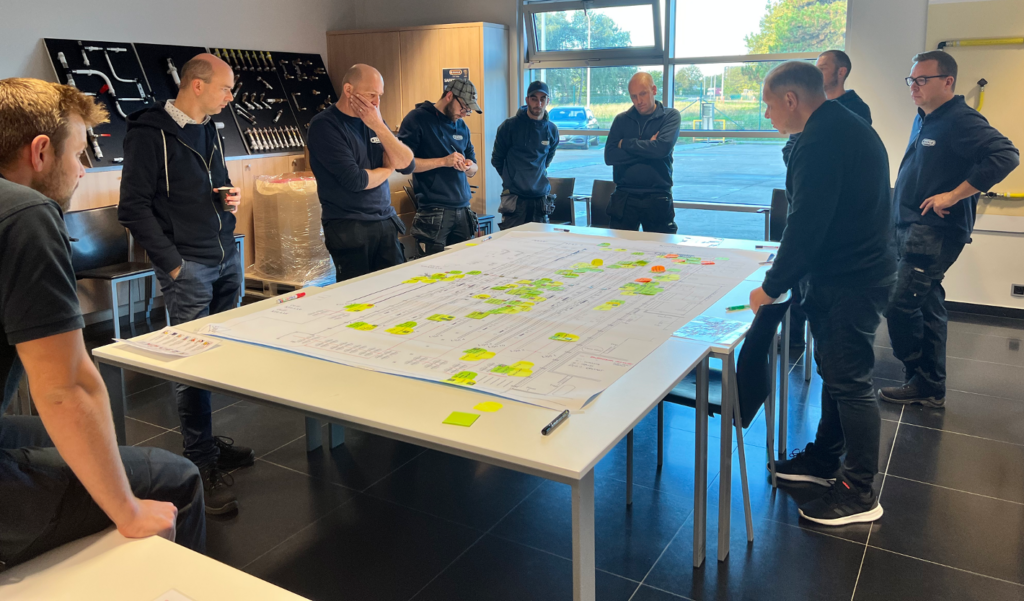
Using floor plans and heat maps, we work together to build a comprehensive risk assessment. This involves looking not only at what could go wrong, but also at the measures already in place, and where there is still room for improvement.

Contents:

  • Identifying hazards and risks at each workstation
  • Visualising these using floor plans and heat maps
  • Mapping existing control measures
  • Assessing residual risks
  • Introducing and applying the hierarchy of prevention
  • Identifying areas for improvement
  • Developing a widely supported “mini-RIE” as a reality check on existing analyses

Why?

Many risk assessments exist on paper but are not sufficiently implemented in the workplace.

By actively involving employees in the risk assessment process, we not only gain a more accurate picture but also build stronger support for the results and the actions that follow.

In practice, participants also become aware of something striking: they are often familiar with the hazards but give less attention to existing measures and residual risks.

This training helps to restore that balance and makes safety not just a system, but something tangible and open to discussion, leading to widely supported agreements.

Banzai!

After this training:

  • You will have a clear overview of the hazards and risks at your workstation
  • You will be aware of existing control measures and residual risks
  • You will understand how the hierarchy of prevention is applied in practice
  • You will be able to identify and highlight areas for improvement
  • You will actively contribute to shared agreements on safe working

Curious about more?
Want a quote?

We are happy to help.

Didn't find what you were looking for?